
How to run an online team store
Team stores turn fifty separate orders into one tidy batch.
Set clear dates
Open for two to three weeks with a countdown, then close and print everything together.
Use player packs
Shirt, shorts and socks in one form, with the name and number typed once, mean fewer mistakes.
Give the organiser a view
Coaches want to see who has ordered and what sizes to hand out.
What an online team store is
An online team store is a small shop just for one club, team or group. Members, players and parents visit it, pick their items and sizes, add a name and number if needed, and pay. The store is open for a set time. When it closes, the decorator produces every order together and delivers them in one go. For the club, it means no spreadsheets, no chasing money and no handing out the wrong sizes. For the decorator, it turns many small orders into one efficient run.
Who uses team stores
- Football, rugby, cricket, netball, hockey and basketball clubs, from juniors to adults.
- Running, cycling and swimming clubs.
- Schools for sports kit, PE kit and leavers wear.
- Dance schools, martial arts clubs and gyms.
- Charity events, fun runs and tournaments.
- Companies and staff groups for events and uniform.
Before you open: agree the details
Most team store problems start before the store opens. Sit down with the organiser and agree these points in writing:
- Which items to sell and in which colours. Fewer choices mean faster decisions and fewer mistakes.
- Which sizes, including children's sizes, and whether a size guide is needed.
- Whether names, numbers or initials are included, optional or not offered.
- Prices, and whether the club adds an amount per item for fundraising.
- Open and close dates, and when the club needs the kit.
- Delivery: one box to the club, or each order posted to the buyer's home.
- Who the organiser is, and who answers questions from parents and players.
Getting the timing right
Two to three weeks is long enough for most people to order and short enough to keep a sense of urgency. Work backwards from the date the club needs the kit. Allow time for blanks to arrive, for production and for delivery, and add a few days of slack. Send a reminder halfway through and another a day or two before it closes. A countdown on the store helps. Most orders tend to come in at the start and right before the close, so plan your messages around both.
Use player packs
A player pack bundles the items a player needs, such as shirt, shorts and socks, into one choice. The buyer picks a size for each item and types the name and number once. Packs reduce missing items, speed up ordering and make packing easier, because each player's items belong together. Offer optional extras, such as a training top or a bag, alongside the pack.
Names, numbers and sizes
Personalisation is where mistakes cost money. Ask for names exactly as they should print, and show a preview where you can. Limit the length of names. Decide whether numbers can repeat. For junior teams, a coach may prefer to assign numbers from a roster rather than let parents choose. A size guide with measurements, or a sizing kit the club can try on, saves returns.
Fundraising in a team store
Many clubs add a fixed amount to each item to raise money. Show the goal and the progress on the store, because people like to see where the money goes. Agree up front how and when you pay the club its share, and keep a clear record of what was raised per order. Be clear with buyers that part of the price supports the club.
Pricing a team store
Price store items per piece, not per job. Because every order is produced together when the store closes, you can usually waive one-off setup charges and still make a fair margin. Build in the cost of names and numbers, packing by player and any delivery. Show prices with tax included where buyers expect it, and keep prices the same for the whole time the store is open.
Promoting the store
The decorator builds the store, but the club sells it. Give the organiser what they need: a short message with the link and close date, a few photos or mockups of the items, and a reminder message to send later. Ask them to share it in their group chats, on social media and in their newsletter. The best results come when a coach or captain tells the team to order.
After the store closes
- Close on time. Late orders can go into a second, later store.
- Order blanks for every size and colour sold, plus a few spares.
- Produce everything as one batch with one set of worksheets.
- Pack by player or by order, label each bag clearly, and check names against the order list.
- Deliver in one box to the club, or post orders to each home if that was agreed.
- Send the organiser a summary of orders, sizes and money raised.
Mistakes to avoid
- Too many items and colours, which slows decisions and spreads orders thin.
- A close date too near the date the kit is needed.
- No clear owner at the club for questions.
- Adding late orders one by one after production starts.
- Unclear delivery, so parents do not know where to collect.
Team stores in Dyenzo
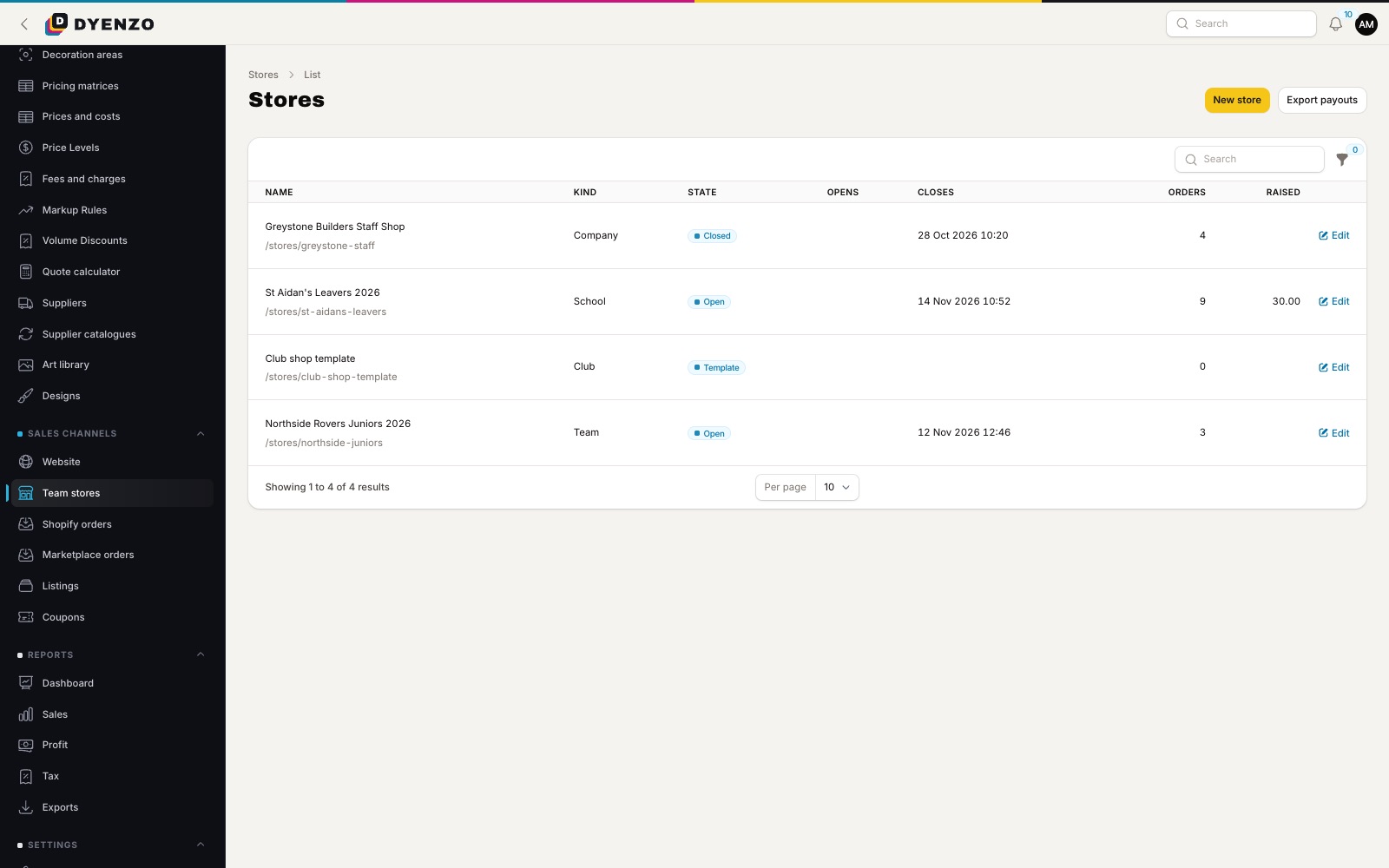
In Dyenzo a store opens and closes on its dates with a countdown, sells player packs with the name and number typed once, and adds a fundraising amount on every order. When it closes, every order becomes one production batch with worksheets, pull sheets and packing lists. The organiser signs in to see orders, sizes and money raised.
Questions
How long should a team store stay open?
Two to three weeks suits most clubs. Shorter stores keep urgency high; longer ones rarely bring many more orders and delay production.
Should orders ship to homes or to the club?
Delivery to the club in one box is cheaper and simpler. Home delivery suits clubs spread over a wide area, but each buyer pays for postage.
Can a club raise money from its team store?
Yes. A fixed amount per item is added to the price and paid to the club after the store closes. Agree how and when it is paid before the store opens.
What if someone misses the close date?
Open a short second store later and produce those orders as a separate batch. Adding single late orders to a running batch causes errors.
Dyenzo is opening to its first print businesses
Write to us for early access. Tell us what you print and which modules you need.