
How to start a screen printing business
A practical outline for your first year, from the first press to repeat customers.
1. Start with a niche
Local clubs, schools, workwear or events: one group you can reach gives you repeat orders and word of mouth.
2. Price for profit from day one
Garment cost, a charge per colour and location, setup per screen and a markup. Use a price matrix so every quote is consistent.
3. Put the paperwork in one place
Quotes, art approvals, job tickets and invoices drift apart quickly. One system saves hours a week and avoids reprints.
Is screen printing the right method to start with?
Screen printing is still the cheapest way to put the same design on a lot of garments. Once the screens are made, each extra print costs very little. The catch is setup: every colour needs its own screen, and that takes time. So screen printing suits runs of a few dozen pieces and up, with designs of one to four spot colours. If most of your enquiries are for one-off shirts with photos on them, DTF or DTG may fit better. Many shops start with screen printing and add a heat press and DTF transfers later for small or full-colour orders.
The equipment you need
You can start in a garage or a small unit with a basic setup and grow from there. The core list looks like this:
- A manual press. A four colour, one station press is the usual starting point. A four by four or six by six gives you room to grow.
- Screens and mesh. A mid mesh count such as 110 or 156 covers most plastisol work. Higher counts suit fine detail and water-based inks.
- Emulsion, a scoop coater and a dark, dust-free place to dry coated screens.
- An exposure unit. An LED unit gives sharper, quicker exposures than a lamp.
- Film positives, printed on an inkjet printer with film and good black density.
- A washout area with a pressure washer, plus screen reclaim chemicals.
- A flash dryer for underbases and for curing small runs.
- A conveyor dryer once volume grows. Curing a full run with a flash dryer is slow and less consistent.
- Inks, squeegees in a couple of widths, pallets, tape, spray adhesive and a temperature gun to check cure.
Prices for all of this change often, and secondhand kit is common. Check current prices with UK and US equipment suppliers, and look at used presses and dryers from shops that are upgrading. Spend more on the exposure unit and the dryer than you think you need. Poor exposures and under-cured prints cause more reprints than anything else.
Space, safety and the boring bits
You need power for the dryer, ventilation, a water supply and drainage for the washout area. Check that your lease or planning rules allow light industrial use. Keep the safety data sheets for your inks and chemicals. In the UK, the COSHH rules cover how you store and handle them. In the US, OSHA rules apply once you have staff. Get insurance before your first paid job: public liability in the UK, general liability in the US, and cover for customer garments while they are in your hands.
Register the business
In the UK, most people start as a sole trader and register with HMRC for Self Assessment, or set up a limited company through Companies House. You must register for VAT once your taxable turnover passes the VAT threshold in any rolling 12 months. Check the current figure on GOV.UK. Some shops register early so they can reclaim VAT on equipment, but that means adding VAT to your prices for customers who cannot reclaim it.
In the US, you can start as a sole proprietor or form an LLC with your state. Get an EIN from the IRS, which is free. You will need a sales tax permit in your state, and a resale certificate lets you buy blank garments without paying sales tax on them. Sales tax rules vary by state, and selling online into other states can create obligations there too. Speak to an accountant early; it is cheaper than fixing mistakes later.
Buying blanks
Open trade accounts with the main blank garment wholesalers in your country. Most offer next day delivery, so you do not need to hold much stock at first. Order blanks for each job once the customer has paid a deposit. Keep a short list of core styles you know well: a tee, a heavier tee, a hoodie, a sweatshirt and a polo. Knowing how each one prints, washes and fits saves you from surprises.
Pricing your first jobs
New printers often price too low and then cannot raise prices without losing customers. Build every price from the same parts: the garment cost plus a markup, a print charge per colour per location, and a setup charge per screen spread over the quantity. Then add a price matrix with quantity breaks so a quote takes a minute, not half an hour. Set a minimum order quantity, often somewhere between 12 and 24 pieces for screen printing, and point smaller orders to a transfer method. Our guide on how to price screen printing and the free calculator walk through the maths.
Finding your first customers
Start close to home. Local sports clubs, schools, trades businesses, charities, gyms, bands and event organisers all buy printed garments, and most of them reorder. A few ways to reach them:
- Print shirts for one club or event at a fair price and ask for a mention.
- Visit trades businesses and offer workwear with their logo. Bring samples.
- Set up a Google Business Profile so local searches find you.
- Show your work on Instagram and Facebook, with photos of real jobs, not mockups only.
- Offer online team stores to clubs and schools so members order and pay on their own.
- Get on the supplier list of local event organisers and promotional products distributors.
Aim for repeat customers over one-off orders. A club that orders kit every season is worth far more than a single big job, and they will tell other clubs about you.
A simple workflow from quote to delivery
Even a one-person shop needs the same steps every time. Skipping one is how wrong colours and missing sizes happen.
- Quote: garments, colours, locations, quantities and the date needed.
- Deposit and approval: take a deposit and get the customer to approve a proof showing placement, size and ink colours.
- Order blanks as soon as the proof is approved.
- Prepare the art, print films and burn screens.
- Print, cure and check a test piece. Do a wash test on new ink and garment combinations.
- Count, fold, pack and invoice the balance before release.
Mistakes to avoid
- Starting on a press with too few stations to print the jobs you want.
- Printing without a signed-off proof, then paying for the reprint.
- Not testing cure. A print can look fine and crack after the first wash.
- Saying yes to every rush job without a rush fee.
- Keeping orders in emails, notebooks and your head.
Where Dyenzo fits
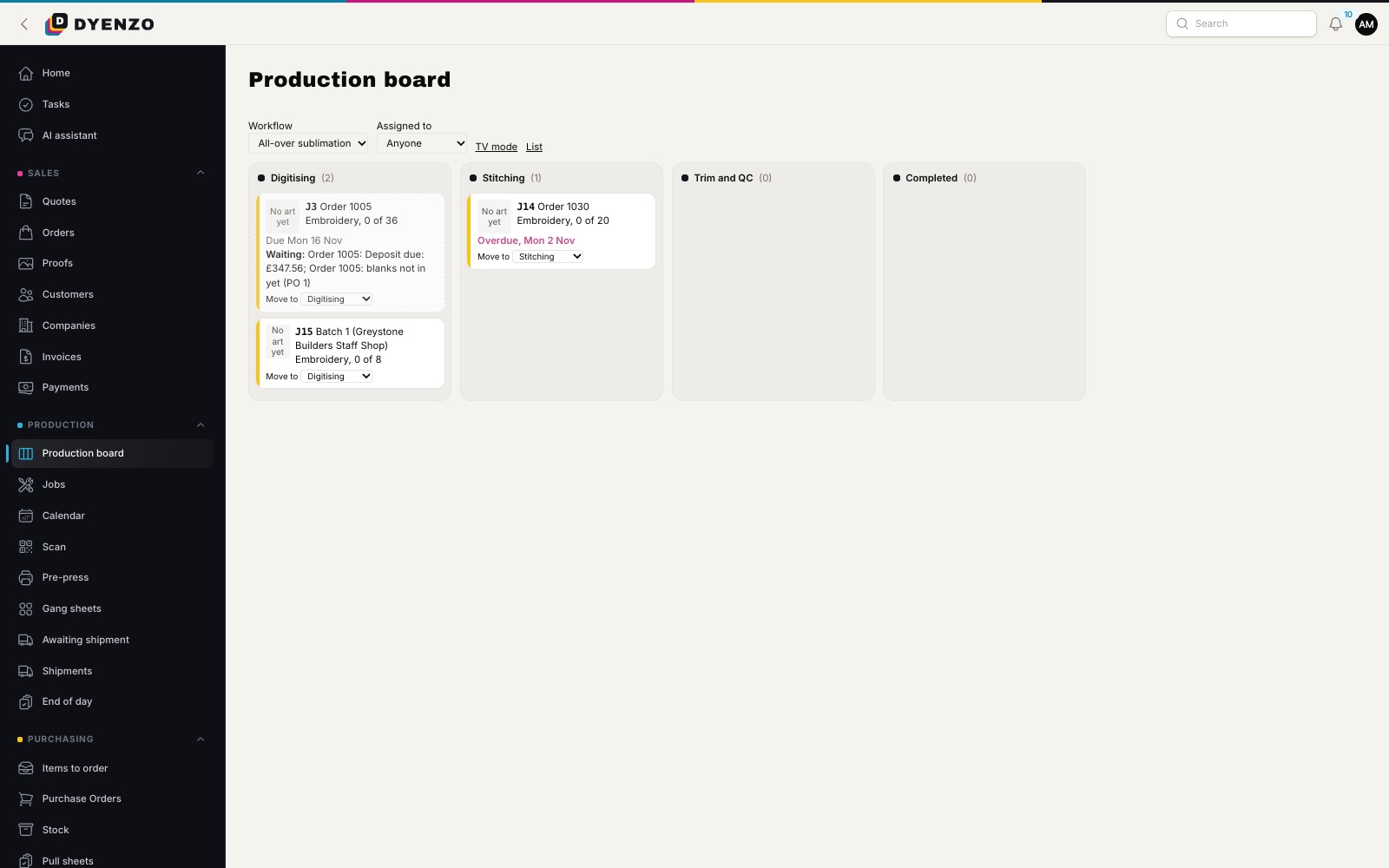
Dyenzo runs the office side of a decoration business: quotes priced from your own matrices, proofs customers approve online, job tickets and a production board, purchase orders for blanks, invoices with UK VAT or US sales tax, and online stores for clubs and schools. It is useful once you have more jobs than you can keep track of on paper.
Questions
How much does it cost to start a screen printing business?
It depends on whether you buy new or used kit and how big you start. Price a press, exposure unit, flash dryer, screens, inks and washout setup from current supplier lists, then add insurance, blanks for samples and a few months of running costs.
Can I run a screen printing business from home?
Many people start at home, but check your lease, mortgage, insurance and local planning rules first. You need ventilation, water and drainage for screen washout, and enough power for a dryer.
Do I need to register for VAT or sales tax?
In the UK you must register for VAT once taxable turnover passes the threshold in a rolling 12 months; check the current figure on GOV.UK. In the US you usually need a sales tax permit in your state before you start selling.
What should I print first?
Pick one group you can reach, such as local clubs or trades businesses, and print for them well. Keep to a few garment styles and simple designs until your process is reliable.
Related
Dyenzo is opening to its first print businesses
Write to us for early access. Tell us what you print and which modules you need.